Bronya: A Playful Display Font for Handmade Creators
If you've ever stared at a blank label, sticker sheet, or wedding welcome board wondering how to make it feel *just right*—not too stiff, not too fussy, but full of personality and charm—you’ll love Bronya. As a maker who designs printable planners, cuts vinyl for boutique tags, and hand-presses greeting cards for local shops, I reach for Bronya when I need a display font that’s bold enough to command attention, yet neat enough to keep things feeling intentional—not chaotic.
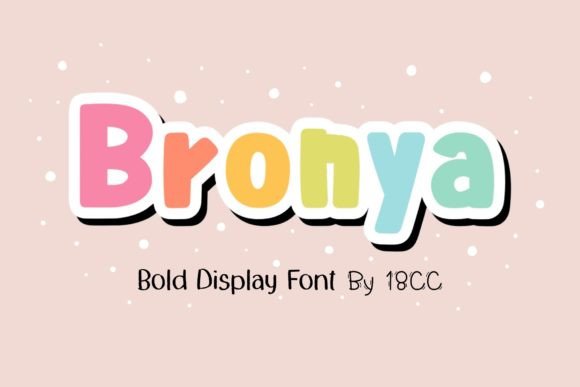
Bronya is a playful and neat display font. That duality is rare—and incredibly useful. Its letterforms have friendly curves, subtle bounce, and clean lines that hold up beautifully on physical products. It’s not a script, not a serif, not a strict sans serif—it lives in its own joyful space. Think of it as the typographic equivalent of a hand-painted sign outside a small-batch candle shop: warm, confident, and quietly memorable.
Where Bronya Shines in Real Craft Projects
I use Bronya most often where impact matters more than length: product names on apothecary-style candle labels, “Welcome” on farmhouse-style wooden signs, “Happy Birthday!” stamped across kraft paper gift tags, or “Est. 2023” on woven cotton tote bags. Its bold weight ensures crisp cuts on Cricut and Silhouette machines—even at 18–24pt sizes—and its generous spacing prevents letters from merging during vinyl weeding or ink bleed on uncoated cardstock.
For digital printables, Bronya adds instant character without sacrificing clarity. On planner cover pages, it reads cleanly at 48pt on an 8.5" x 11" PDF. On printable wall art (think minimalist quote prints for nurseries or coffee shops), it holds presence even when scaled down to 36pt with tight kerning adjustments. And because it’s designed as a display font—not meant for paragraphs—it never tempts me to overuse it in body text, which keeps my designs balanced and professional.
Practical Pairings & Design Flow
Bronya thrives when paired thoughtfully. For greeting cards or wedding stationery, I often combine it with a relaxed handwritten font for names or dates—say, “Emma & Liam” in a soft script beneath “You’re Invited” in Bronya. For packaging or boutique tags, I pair it with a clean, neutral sans serif (like Montserrat or Inter) for ingredients, care instructions, or small-print branding. The contrast gives hierarchy without competing.
On seasonal product lines—like holiday mugs or spring-themed stickers—I’ve found Bronya works especially well with simple serif fonts (e.g., Lora or Merriweather) for secondary text. That combo feels timeless but never dated, crafty but not kitschy. It also scales gracefully across formats: same file, same visual language, whether it’s printed on a 2” round sticker or laser-cut into ¼” acrylic signage.
What You’ll Actually Get (and Why It Matters)
Bronya comes as a single, well-hinted OTF file—no extra weights or styles, but that’s intentional. As a display font, its strength lies in consistency and focus. There are no swashes or alternates cluttering your glyph panel, which means faster design time and fewer decisions mid-project. It supports basic Latin characters (A–Z, numbers, common punctuation), so it’s perfect for English-language product names, shop signage, and social media graphics—but double-check if you need extended language support before using it for multilingual packaging.
File format simplicity also means reliable performance in Canva, Affinity Designer, Adobe Illustrator, and even older versions of Silhouette Studio. No font substitution surprises, no missing glyphs on mockup previews—just what you see is what you cut or print.
Commercial Use? Yes—But Know the Boundaries
Like all quality display fonts, Bronya includes a commercial license—meaning you can use it to design and sell physical products (stickers, mugs, t-shirts, packaging), digital downloads (printable planners, SVG bundles, Canva templates), and client work (logo concepts, shop signage, invitation suites). Just remember: you cannot resell the font file itself, embed it in apps or web fonts without extended licensing, or claim Bronya as your own original typeface.
For Etsy sellers, this means you’re fully covered to use Bronya on your candle labels, wedding welcome boards, or digital party kits—as long as the end product isn’t the font file. That clarity saves time, avoids platform takedowns, and lets you focus on what you do best: making things people love to buy.
When to Reach for Bronya—And When to Pause
Reach for Bronya when you need:
- A short, expressive headline on a greeting card or gift tag
- Product naming on handmade soap or tea packaging
- Decorative accents on printable wall art or planner inserts
- Shop signage or market booth banners that must read clearly from 6 feet away
- Digital download covers that stand out in crowded Etsy search results
Pause before using Bronya for:
- Long blocks of body text (it’s not built for readability at small sizes)
- Ultra-thin vinyl cuts under 12pt (letter counters may close or fill in)
- High-contrast black-on-white labels with fine detail—test print first
In my studio, Bronya has become the go-to for anything that needs to say, “This was made with care—and a little joy.” It doesn’t shout. It grins. And in a marketplace full of polished-but-impersonal designs, that quiet confidence makes all the difference.